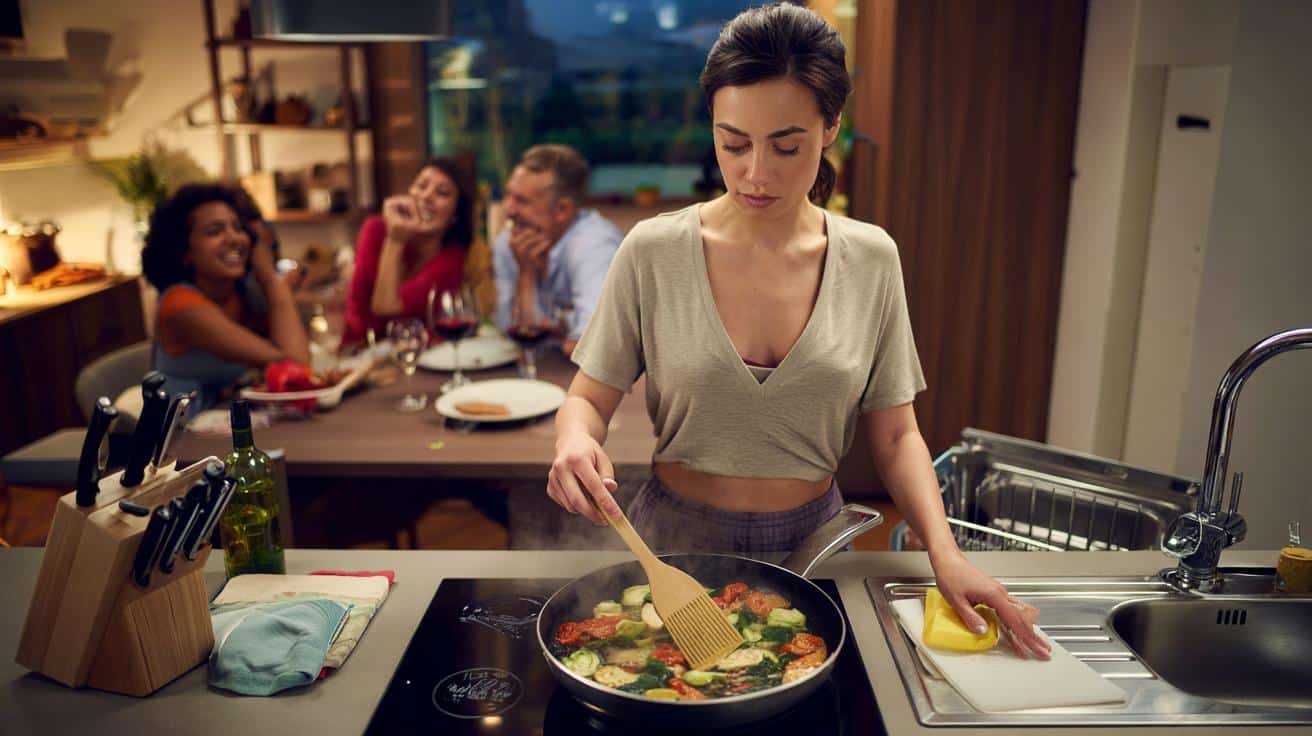
The pan is still sizzling, the pasta smells like heaven, and your friends are already sitting at the table… but you? You’ve got a sponge in your hand and one eye on the sauce. While everyone else would just drop the spoon and say “I’ll clean later”, you’re wiping the counter, rinsing the cutting board, stacking dishes with a weird kind of quiet pride. The sink is almost empty before the food even lands on the plates.
Some people roll their eyes. Others are secretly impressed.
Psychologists say this impulsive “clean as you go” habit says much more about you than just being “tidy”.
It reveals a whole hidden mental structure.
Wer beim Kochen sofort aufräumt: mehr als nur ordentlich
Watch people in a shared kitchen and you’ll see two very different species. There are the creative tornadoes: flour on the floor, open jars everywhere, three knives for one tomato. And then there are those who stir with one hand and clear with the other, moving like they have a built-in radar for chaos. That second group often gets labeled as “control freaks” or “cleaning obsessives”, yet something deeper is going on.
When you clean while cooking, you’re juggling tasks, space and time at once. That’s not just habit, that’s cognition in action.
Picture Jana, 32, who cooks for her friends every Friday. She loves trying new recipes, the more complicated the better. But if you watch her, you’ll notice a pattern. While the onions caramelize, she quickly rinses the knives. As the water heats, she wipes down the counter. Waiting for the cake to bake, she already loads the dishwasher.
By the time guests sit down to eat, the kitchen looks like nobody has used it. Her friends laugh: “You’re crazy, how do you do that?” Jana shrugs and says, “I just hate the feeling of a bombed kitchen behind me.”
Psychologists talk about something called “low chaos tolerance”. People like Jana feel visual mess more intensely, almost like background noise in their brain. Clearing as they go brings their inner system back to calm. At the same time, this habit usually points to strong executive functions: planning, anticipating the next step, organizing actions in the right order.
*It’s not just that they “like it clean” – their brain is constantly trying to close small open loops before they turn into stress.*
➡️ Warum bewusstes weglassen oft mehr bringt als neue vorsätze
➡️ Warum Rotkehlchen Ihren Garten nicht mehr verlassen, wenn sie dieses saisonale Futter entdecken
➡️ Diese alltägliche bewegung schützt deine gelenke besser als sport
Die 9 besonderen Eigenschaften hinter dem Sofort-Aufräum-Reflex
First, there’s emotional self-regulation. If you wipe down the counter while the soup simmers, you’re not just saving time. You’re lowering your own stress level before it spikes. These people sense micro-tension early. They think, “If I leave this, I’ll be annoyed later,” and their body reacts now. That’s an underrated psychological skill.
Second comes foresight. **Wer beim Kochen sofort aufräumt, denkt in Zukunftsbildern.** They picture the end of the evening: full stomach, tired body, and then… a mountain of sticky pans. So they frontload the effort when they still have energy.
Third, there’s a subtle respect for others. Many instant-cleaners grew up in families where the kitchen was shared, or where one person was always left with the “dirty work”. They unconsciously refuse to repeat that pattern. When you see someone wash the pan before they’ve even eaten, there’s often a story behind it: a parent always standing alone at the sink, a partner who carried the invisible workload.
Fourth, there’s attention to detail. These people notice the little spill on the stove, the knife slightly off to the side, the open drawer. That can be exhausting in other areas of life, yet in the kitchen it becomes a superpower. Things don’t pile up as easily because their radar catches small messes early.
Fifth, psychologists tie this habit to a certain identity. People who clean while they cook often tell themselves: “I’m someone who leaves things better than I found them.” This quiet self-image guides dozens of micro-decisions. Sixth, there’s a strong sense of completion. They don’t just want a finished meal, they want a finished scene: food on the table, kitchen reset, evening truly free.
Seventh comes autonomy. They don’t like depending on “later me” or someone else to handle consequences. Eighth, there’s usually a disciplined side that spills into work, money, relationships. Ninth, paradoxically, they’re often more relaxed socially. With the mess under control, their mind is freer for conversation and presence. Let’s be honest: nobody really does this every single day.
Wie du diese Mentalität nutzen kannst – ohne dich zu überfordern
You don’t have to turn into a perfect kitchen robot to benefit from this psychology. One simple method that many therapists recommend is the “30-Sekunden-Regel”. If a task takes under 30 seconds while you’re already standing there, you do it immediately: rinse the spoon, wipe the splash, close the cupboard. This builds the same mental muscle instant-cleaners use, without turning dinner into a bootcamp.
Another trick: pair cleaning with natural waiting times. Water boiling? Clear two items. Oven preheating? Load a few dishes. You surf on the dead time instead of scrolling your phone.
The biggest mistake people make is turning this into another harsh rule. “I must always cook and clean at the same time, or I’m lazy.” That thought kills motivation instantly. The goal isn’t a showroom kitchen, it’s inner lightness. Some evenings, your energy is gone, the day was too long, and yes, the pans will wait until tomorrow.
Be kind with that version of you. What matters is the general direction, not perfection. A tiny habit that you repeat three times a week beats a heroic cleaning marathon once a month.
„Die Art, wie wir mit kleinen Alltagsaufgaben umgehen, verrät sehr viel darüber, wie wir innerlich Ordnung schaffen – oder vermeiden.“ – eine häufig zitierte Beobachtung aus der Alltagspsychologie
- Mikro-Schritte einbauen: Nicht “die ganze Küche”, nur das Brett, nur das Messer, nur die Pfanne.
- Warten aktiv nutzen: Während etwas köchelt, immer nur eine Kleinigkeit erledigen.
- Perfektion verbannen: Kleine Flecken dürfen bleiben, Fokus auf die größten Störquellen.
- Rituale schaffen: Zum Beispiel immer zum Schluss einmal kurz Spüle und Herd abwischen.
- Eigene Grenze kennen: An anstrengenden Tagen ist “später” keine Schwäche, sondern Selbstschutz.
Warum dich dein Umgang mit der Küche so viel über dich selbst lehren kann
Wenn du das nächste Mal kochst, beobachte dich im Stillen. Greifst du automatisch zum Schwamm, sobald etwas frei wird? Lässt du alles stehen, bis der Hunger gestillt ist? Oder schwankst du irgendwo dazwischen, je nach Tagesform? Diese kleinen Gesten erzählen leise Geschichten über deine Bedürfnisse, deine Grenzen, deine Art, mit Stress und Verantwortung umzugehen.
Vielleicht erkennst du plötzlich: Ich räume sofort auf, weil ich Chaos aus der Kindheit nicht mehr ertragen will. Oder: Ich lasse alles stehen, weil ich mir im Alltag nie erlaube, einfach nur zu genießen. Beide Varianten sind keine Charakterfehler, sondern Spuren deiner Geschichte.
Wenn Psychologie von neun besonderen Eigenschaften bei Menschen spricht, die während des Kochens direkt aufräumen, meint sie nicht ein Ranking von “besser” und “schlechter”. Gemeint sind Fähigkeiten wie Vorausdenken, Selbstregulation, Verantwortungsgefühl, Detailwahrnehmung, Abschlussliebe, Autonomie, Fürsorge, Disziplin und soziale Präsenz. Manche davon trägst du vielleicht stark in dir, andere schlummern noch.
Die Küche wird dann zu einem Mini-Labor: ein Ort, an dem du ausprobieren kannst, wie du mit dir selbst umgehen willst. Weniger Schuld, mehr Bewusstsein. Weniger “ich muss”, mehr “was tut mir wirklich gut?”.
| Key point | Detail | Value for the reader |
|---|---|---|
| Clean-as-you-go zeigt psychologische Stärken | Hinweis auf gute Selbstregulation, Planung und geringe Chaos-Toleranz | Eigenes Verhalten einordnen und nicht nur als “Ordentlichkeit” abtun |
| Kleine Gewohnheiten statt Perfektion | 30-Sekunden-Regel, Warten nutzen, Mikro-Schritte | Praktische Wege, um Stress zu senken, ohne sich zu überfordern |
| Küche als Spiegel der Biografie | Aufräumverhalten verknüpft mit Erfahrungen aus Familie und Alltag | Sich selbst besser verstehen und freundlicher mit eigenen Mustern umgehen |
FAQ:
- Ist es zwanghaft, wenn ich beim Kochen immer sofort aufräume?Nein, nicht automatisch. Entscheidend ist, ob du dich dabei frei oder innerlich unter Druck fühlst. Wenn du entspannter bist, wenn es ordentlich ist, ist es eher ein Selbstberuhigungsritual als ein Zwang.
- Was sagt es über mich aus, wenn ich alles erst nach dem Essen aufräume?Das kann bedeuten, dass Genuss und Präsenz für dich Vorrang haben oder dass du Chaos mental besser ausblenden kannst. Es macht dich nicht weniger diszipliniert, solange du die Küche später wirklich in Angriff nimmst.
- Kann ich lernen, während des Kochens aufzuräumen, obwohl ich das nie getan habe?Ja, wenn du klein anfängst. Eine Fläche sauber halten, ein Messer direkt spülen, eine Pfanne einweichen – diese Mini-Schritte können sich zu einer neuen Gewohnheit entwickeln.
- Macht “Clean as you go” wirklich weniger Stress?Viele Menschen berichten genau das. Weniger visuelle Reize, weniger “offene Loops” im Kopf, der Abend endet ruhiger. Gerade nach langen Tagen kann das einen großen Unterschied machen.
- Bin ich pingelig, wenn mich eine unaufgeräumte Küche extrem stört?Du hast vermutlich eine niedrige Chaos-Toleranz und nimmst Unordnung stärker wahr als andere. Das ist eine Temperamentsfrage, kein Makel – wichtig ist nur, dass du anderen ihre andere Art nicht abwertend auslegst.